Jagdish N. Sheth Columbia University A panel of foreign nationals reveals the importance of generalization and information in the development of brand loyalty.
In recent years a variety of approaches have been I tried in order to understand buyers’ brand preferences and brand loyalty (Sheth. 1967). Several researchers have attempted to explain the dynamics of brand loyalty by learning theory in one form or another. Kuehn (1958 and 1962), for example, baa advocated a linear learning model based upon the subject-controlled sequence type of learning described by Bush and Mosteller (1985). Similarly Haines (1964) has given an aggregate theory of diffusion of innovations based upon the same type of learning. Tucker (1964) and Krugman (1962) have experimentally observed the development of brand loyalty utilizing learning principles. Howard (1963), and Howard and Sheds (1968) have heavily relied on learning principles to develop a theory of buyer behavior.Learning Theory and Brand Preference
At a general level, learning gives direction to behavior as regards choosing one course of action over a number of courses of action. This is in contrast to the role of motivation in behavior as the force or impelling agent. At the behavioral level, learning is generally defined as a systematic change in behavior (Bush and Mosteller, 1955. p. 3). In experimental psychology, repeated experience is considered a major source of learning especially in animal behavior and in simple human behavior. Each alternative course of action is considered to entail certain consequences which act as feedback in restructuring the hierarchy of alternative courses of action. But in complex human behavior, which includes much of the sign behavior manifested in language encoding and decoding processes, it is generally recognized that two other sources become equally relevant: generalization and information. Generalization means transferring a learned response from one stimulus to another similar stimulus, Brand generalization is a good example. The role of information in learning is primarily related to complex cognitive processes whereby the person establishes favorable attitude toward or preference for a course of action in instances where he lacks experience. He therefore learns by actively seeking information about the various brands which form his evoked choice set, in many instances, to minimize the cost and effort of seeking information, the buyer may simply imitate the behavior of his reference group. Intuitively, learning seems very relevant as a conceptual explanation of brand loyalty. Both learning and brand loyalty are processes which are manifested over a period of time and in both cases, there arises a habitual course of action which is dominant in a given situation. However, researchers have more often than not generalized learning as an explanatory hypothetical construct in empirical situations which do not possess relevant data. They have taken existing data and have attempted to explain the phenomena of brand switching and brand loyalty in terms of learning instead of collecting the data explicitly to test the relevance of learning in buying behavior and as an explanation of the development of brand loyalty. In the process, its construct validity (Cronbach and Meehl, 1955) has been seriously questioned. Since learning is a hypothetical construct—not directly observable, but inferred as an explanatory variable from manifest behavior—it needs careful validation procedures; these have been lacking in consumer behavior. Several researchers have, therefore, recently questioned the relevance of learning in the development of brand loyalty (Frank, 1962; Many and Frank, 1964; Montgomery, 1966). This paper provides a naturalistic experimental design where learning can be tested with appropriate data.Normal Panels Not Appropriate
To measure brand loyalty dynamics, it is essential that repeated measures of the purchase patterns of a sample of buyers be obtained over time. Strict cross-sectional data obtained by one time surveys are not therefore appropriate. Aggregate time-series data also become inappropriate because repeated measures of the same households are not available. The measures must therefore necessarily be obtained from fixed panels of the buyers who will repeatedly give the desired information—be it actual purchase history or attitudinal preferences of brands. Fixed panels of buyers are inevitable to understand the development of brand loyalty by the learning process, Goldstein (1959), Webber (1944). Ehrenberg (1964), Goldfarb (1960), Boyd and Westfall (1960), and Granbois and Engel (1965) have shown the distinct advantages of a panel of buyers reporting purchases over time. “The advantage of the panel is that It can reveal not only the total extent of change-—the net change—but also the complete ‘turnover’ who changed and us which direction” (Rosenberg and Lazarsfeld. 1951). To understand the formation and change in brand loyalty as a learning process, the members of the panel must, however, have no prior experience with and consequent preferences for the brands in a product category. This restricts the use of existing panel data such as those collected by MRCA or the Chicago Tribune. For these panels are composed of American households who, by the time they join the panel and report their purchase behavior, probably already have stable brand preferences for many grocery and personal care items resulting from earlier purchase experiences. A number of studies (Guest, 1944, 1964; McNeal, 1965; Wells, 1966) have shown that a person develops awareness of and preferences for brands of several grocery products very early in life. Gilbert (1957) rep orts many studies where he has found that not only do teenagers and adolescents have strong brand loyalty but that they also exert a heavy influence on their parents’ brand choice. To measure the development of brand loyalty by prior repeated experience the data from existing panels are not appropriate—at least as regards product categories which do not cater to any particular phase of the lifecycle of the buyer. But much existing research has used such data, and some have even attempted to support or refute the relevance of learning in products such as coffee, detergent, cereals, and frozen orange juice where brand loyalty is likely to have been established before joining the panels (Kuehn, 1962; Kuehn, 1958; Frank, 1962; Montgomery, 1966). This does not suggest that the panel data are not useful for some purposes. If one wants to measure the extent of learning of brand loyalty, the data will reveal it by several statistical techniques. Such panel data also become extremely useful to monitor the effect of short-term promotional effort. Existing commercial panels are also relevant when the researcher wants to measure the development of brand loyalty for a new product. Under this circumstance prior experience is lacking, and the total effect of repeated purchases can be obtained. Kuehn (1958, 1962), obtained Chicago Tribune data on concentrated frozen orange juice at a time when it was an innovation. The industry was only four years old and had 19 per cent of sales volume of all orange products (Kuehn, 1958). Kuehn attempted to measure brand loyalty as a learning process at a time when the innovation was rapidly diffusing indicating that many new users entered the market in the time period analyzed. The market share rose from 19 per cent to 40 per cent during that time and the physical consumption of frozen orange juice rose by 170 per cent. Kuehn’s data seem legitimate so test relevance of learning because many buyers were likely to have no prior experience and consequent brand preferences. However, several problems still exist in the data. First part of Kuehns sample may already have been loyal to a brand of frozen orange juice because the industry was four years old. Second, other sources of learning may exist and could account for learning. For example, in case of actual product change the buyer may generalize brand preference to a great extent from past experience with similar product categories, in this instance, other orange products marketed by the same brand. Third, for many innovations, the diffusion theory (Miller and Dollard. 1941; Rogers, 1962) suggests that imitative behavior may be highly influential in the adoption and continued use of the product. As mentioned earlier, such imitative behavior is an information seeking process. Finally, time lags invariably exist in the introduction of various brands in the market. A totally new product like a miracle drug very often enjoys a monopoly for quite some time. Under these circumstances, there can be no choice among alternative brands. Instead, the buyer decides whether to buy or not to buy—brand choice is automatically decided for him. The uneven entry of new brands may disrupt the learning process (Howard. 1963). In other words, market conditions may change so rapidly that they obscure true measures of brand loyalty as developed from experience. Kuehn shows that such uneven entry of various brands did occur during the period analyzed. “The number of brands in Metropolitan Chicago accounting for as least one per cent of the market rose from eight in 1950 to 14 in 1951 to 17 in 1952” (Kuehn, 1958). Thus to measure the formation of brand loyalty, the data from existing panels are not totally appropriate even for new products. Only in instances where a new brand is introduced in stable market conditions and measures of learning by other sources— generalization and imitative behavior—are properly taken into account, may we obtain learning of brand loyalty by repeated experience.Long Purchase Cycle
Use of purchase information on consumer durables where the buyer is likely to lack any experience also does not seem feasible. Several problems exist. Pint, the average life cycle of many durable appliances is very high—at least eight to ten years. Even if we take into account the high obsolescence rate which may shorten the purchase cycle to say three or four years, it will take a long time to obtain repetitive purchase measures from the panel. Further, the long time interval between purchases may allow market conditions to change markedly, and therefore a stable pattern may not be available. Second existing panels for consumer durables are rare and the few that exist are almost exclusively company-oriented, e.g., General Electric and General Motors Panels. The information is therefore not readily available. Moreover much of the information collected is at the intention level rather than actual purchase. Finally, the successful and rapid diffusion of many minor and major product changes in the durable goods area suggests that possibly both the other sources of learning—generalization and imitation—may exist to a significant extent. One is therefore forced to confine oneself to non-durable goods like food, cosmetic and personal care items. Since brand awareness and brand loyalty for these products seem to occur early in life, one may utilize a panel of young adults. However, numerous procedural problems exist in collecting data from die young adults, particularly if purchase records are required. For example, serious problems of communication, particularly written and through mail, remain. Personal interviewing seems the best method of collecting any information from young adults, but it is not feasible for repeated measures of purchase. Also, two sets of influences on their brand choice may distort data—the imitative behavior both of parents and peer groups, and differentiation between the buyer and the consumer or user: the young adults may not make the buying decisions. The alternative so obtaining real world data is experimental simulation. A fixed panel could be funned which will make the purchase decisions by choosing among a set of brands provided in the experiment; unless the brands are unidentified or still better they are unknown to the respondents, is very likely that choice will be based on past preferences, and the situation becomes analogous to the existing panel data. It is also difficult to control some influences even in experimental situations. For example, the respondents may also purchase outside the experiment, particularly in panel studies lasting a long time. Further, the problems associated with role playing remain. However, suds simulation, with adequate precaution and controls, may prove very fruitful.Panel
The above thinking led to the realization that the best way to measure learning of brand loyalty was to obtain a group of adult buyers who were totally unfamiliar with existing brands. In other words, a group of buyers who will face the decision of brand choice Irons among a number of brands without any prior experience or generalization Irons past experiences with similar brands. These requirements would be met by foreign nationals, particularly from the underdeveloped countries, who come to the U.S. for the first time. They are confronted with a vast number of brands for many food and personal care items. They cannot generalize from past experience because: I. Branded goods are not prevalent in many food and personal care product categories in their own countries. 2. Vast differences in living habits exist between their countries and the U.S. 3. The U.S. brands of many products are not available in their home countries. In some product categories like toothpaste, soft drinks, and soaps, however, some American brands are well-established in most parts of the world. The immediate examples are Colgate. CocaCoIa, and Lux. If appropriate product categories are chosen, however, a panel of foreign nationals may enable us to understand the development of buying habits in adults.Recruiting and Maintaining the Panel
It was decided to obtain the cooperation of 40 to 50 foreign students who came to the U.S. for the first time directly from their home countries. Sample size was restricted primarily because of the limited research funds. The procedures followed in contacting, recruiting and training were Similar to those followed its standard panel recruitment (Allison, Zwick and Brinser, 1958; US. Dept. of Agriculture, 1958; Ferber, 1959; Sudman, 1959; Quackenbush and Shaffer; 1960) but adapted to the specific situation of obtaining the cooperation of foreign nationals at a time when they are adjusting to the new culture. Cooperation was obtained from 42 foreign nationals who were chosen because they satisfied several criteria (see Sheth. 1966). Panel mortality race (Sobol, 1959) was somewhat different in this case as compared with regular panels. Immediately after the panel became operative, six members dropped out because they felt academic pressures would prevent their cooperating satisfactorily. The panel size was thus reduced to 36 members. After this initial dropout the panel cooperated fully until its dissolution. The panel was maintained for 21 weeks starting with the week beginning September 28, 1964 and ending with the week ending February 27, 1965. Each panel member was asked to record purchases of at least eight and not more than ten products out of a total of IS products. The panel received a diary by mail at the beginning of each week. The diary consisted of a mimeographed sheet for each product and was composed of two parts. The first part enabled the member to record the purchase information for the product if he bought it in that week, i.e., purchase time, brand name, quantity of purchase, price paid, and any purchase because of deals, it is similar to the diary used by MRCA. The second part obtained store name, brands considered in making a purchase, time elapsed between purchase and wage, and indication of satisfaction with the products in use. Two other sets of data were obtained from the panel by personal interviews. The first personal interview was conducted immediately after the recruitment and training. Each member of the panel was asked a series of questions related to brand awareness and usage of any American brands prior to his coming to the U.S. Also, by the time the panel became operative two weeks had elapsed. It was, therefore, necessary to obtain information as to any purchases during that time period. A structured interview was conducted for each product the member was supposed to record. A second interview was conducted after the panel had been operating for six weeks to obtain measures which would reveal whether any imitative behavior reflecting personal influence may be responsible for the development of brand preferences. These two interviews were intended, therefore, to obtain measures of any learning due to generalization or imitative behavior.Measures of Generalization as Learning Source
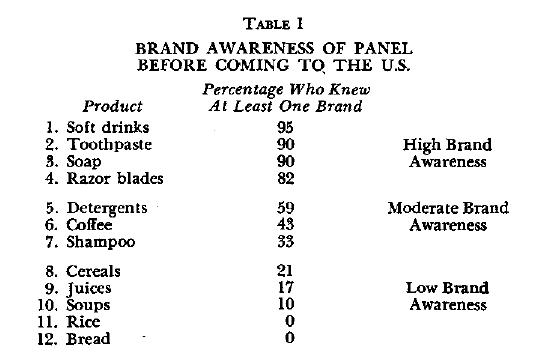
Earlier it was mentioned that learning of habit reflected in brand loyalty can occur by any one of the three processes: repeated experience with a brand, information-seeking by imitative behavior, and generalization. If we want to understand the development of brand loyalty as occurring by expensive only, the other two sources must be either absent in the experimental design or they should be taken into account. In the present study, souse products (toothpaste, soap, soft drinks and razor blades) were deliberately included which would suggest that the panel members may generalize their preference of American brands once they come to the U.S.; while for other products the members may not generalize because they lack any preferences (or American brands. In order to generalize, the buyer must at least be aware of the brand. It is certainly a necessary condition and is very likely to be a sufficient condition if external factors like time pressure persist. Thus a measure of brand awareness may shed light on the possibility of generalization. Table 1 gives the percentage of the panel member who had known at least one American brand before coming to the U.S. (The sample size of three other products was so small that the products were discarded from the analysis.) For products like soft drinks, toothpaste, soap, and razor blades, brand awareness is very high, as was expected. The analysis of the data also reveals that the source of such high brand awareness is actual usage or experience as opposed to information. Detergents, coffee, and shampoo seem to have moderate brand awareness. Brand awareness in these products is based on information as opposed to actual usage or experience. Finally for products like cereals, juices, soups, rice, and bread, brand awareness is low. In fact, foe rice and bread it is nil. Several of the high brand awareness products had lengthy purchase cycles and sufficient repeated purchases could not be obtained, e.g.. toothpaste, soap, razor blades, and shampoo. Several others have high brand awareness and will not be Included in this paper to obviate learning from generalization. We will, therefore, restrict the findings of systematic behavior to rice, bread, soups, juices, cereals, and coffee.Imitative Behavior and Personal Influence
A foreign student coming from a vastly different culture is likely to experience great uncertainty. He does not have decision rules properly suited to the new culture and he dares not generalize the decision rules developed in his own culture for fear that he will be conspicuous. The perceived risk (Bauer, 1960; Cunningham. 1964) is likely to be very high on both the components of risk: the aversive (socially at least) consequences are high, and the Uncertainty of outcome is high. Basset (1964) and Cox (1962) have suggested that in situations where experience is lacking, the buyer is likely actively to seek information which will enable him to establish the necessary decision rules. What is not brought out explicitly, and what seems very relevant for marketing research, is that such active seeking of information may entail imitative behavior particularly in situations where the (social) coat of openly seeking information may be high. This reasoning brings into proper perspective the role of imitative behavior in learning as emphasized by Miller and Dollard (1941), and relevance of this to the diffusion of innovations with the focus on the “influenced” as opposed to the “influential.” It was felt that imitative behavior may very likely occur in the foreign student because a variety of behavioral patterns have to be established within a very short time. He may imitate stay person who was close enough to be considered a ‘friend. Since the imitative behavior we are interested in concerns brand choice followed by the panel member, measures were obtained only with respect so brand following. Since the respondent may deliberately attempt to suppress imitative behavior because of the social role involvement of the leader, an indirect approach was taken. In a personal interview, each panel member was asked three sets of questions. First, he was asked to name two persons as his close friends. The friendship was described in terms of the frequency of social interaction between the panel member and the other person. The respondent was free to say that he had no friend if he believed this was the case at the time of the interview. It was also believed that a person may typically not have more than two close friends, and therefore, restricting to two persons would not affect the measures. The respondent was then asked what brand he himself was currently buying in each of the product categories for which he was keeping purchase records. Once the brand names were obtained he was asked whether he knew the brands of the same products that each of his friends was using. A necessary condition for imitative behavior is that the brands for a given product be identical. However, since identical behavior may also result from parallel independent actions, it is not a sufficient condition. The sufficient condition would be present if the parallel action was the result of matched-dependent behavior or copying (Miller and Doflard, 1949). To measure this, a third question was asked to see whether the knowledge of the friend’s brand had influenced the panel member’s choice. Out of 36 panel members, four had no friends. 11 had only one friend while the rest (21) had at least two friends. Surprisingly, all those members who had at least two friends and who knew the preferred brand of the first friend also knew the preferred brand of the second friend. Similarly, all the panel members who followed the first friends brand preference also followed the brand preference of the second friend except in situations where the brand preferences of the two friends differed. Suds instances of conflict of brand preferences were very few and the panel member decided to follow one or the other friend. Table 2 provides a tabulation which sheds light on the magnitude of imitative behavior for II product categories. Looking at the percentage of the panel who imitated brand choice, it can be said that imitative behavior does exist but the learning of brand preference by this method is limited. The highest level of imitative behavior for any one product is 22 per cent. For most products the imitative behavior is less than 20 per cent of the members using the product. The lack of imitative behavior could be explained by the fact that for the products studied in this report, the establishment of brand choice decision rules does not risk socially aversive consequences. A person will not be frowned upon socially because he uses a certain brand of cereals or toothpaste or bread. From the perceived risk point of view, then, while uncertainty of outcomes may exist, brand decision is not important enough to warrant any imitative behavior. Thus for product categories having low brand awareness, if we obtain indications of brand loyalty, it can be said to have developed by experience over time through repeated purchases of the same brand.Statistical Criteria
Several statistical methods are available to test the null hypothesis that a particular sequence of purchase responses is randomly generated. Grant (1946, 1947) has discussed three suds criteria which are useful in buying behavior and shed some light on the problem of aggregate inference because of spurious contagion pointed out by Frank (1962).Correct Purchases in n Trials
The first criterion deals with the probability that the actual number of ‘correct” responses equals or exceeds a given number us in a sequence of n independent trials where the probability of a chance success of the correct response on a single trial is p. The determination of correct response in brand purchase data is a difficult task. If the researcher is interested in a given brand of a product, purchase of such brand may be considered the correct response. However, in instances where the focus Is not on any given brand, but rather on the determination of brand loyalty generally, the researcher has to make a decision as to which brand for a given respondent may be labeled as correct. It seems reasonable to label as correct that brand which has the highest frequency in a given sequence. In fact, the proportion of a given brand’s purchases among total purchases itself Is a measure of systematic behavior as will be explained below. The first criterion determines the probability that the actual number of correct brand purchases equals or exceeds a given number m, and it involves the binomial distribution. The exact probability of m correct purchases in a sequence of n total purchases cars be calculated by,P m = C n m p m q n-m
The total probability that a buyer will do as well as or better than m correct purchases can then be obtained by, If the null hypothesis that the buyer is purchasing randomly is to be tested, then p = .5 and q = 1 - p = .5 where p = probability of buying the correct brand and q = probability of buying all other brands on a single trial. Thus if the buyer buys on 19 out of 25 trials some correct brand, then p = .5 and is = 25. The probability of the buyer’s purchasing 19 or more correct purchases by chance will be .0073 which may be obtained from tables of the binominal distribution. We can also obtain approximate total probability of obtaining m or more correct purchases in a given sequence of purchases by utilizing the normal distribution. Grant provides an equivalent x 2 measure with one degree of freedom: Where m = correct responses, a = incorrect responses. n = total responses. The last term in the numerator is to be added if the sum of the preceding terms is negative and is to be subtracted if that sum is positive. This formula for p = q = .5 to test the null hypothesis of chance behavior reduces to where again the addition or subtraction of the last term in the numerator depends upon whether the sum of the preceding terms is respectively negative or positive. The above equation is easy to work with in order to test the null hypothesis that a proportion of correct responses is due to chance. Thus a simple Lest of the null hypothesis of random behavior in a sequence of purchase responses is the total number or proportion of correct purchases in a set of purchases. However, “statistical criteria based upon total correct responses are satisfactory only if the experimenter is concerned with overall performance” (Grant. 1946, p. 273). They do not provide a complete test of what is happening, particularly in instances where there are abrupt shifts in modes of behavior. For example, if a buyer has been purchasing two brands randomly for the first 13 trials, and then buys only one brand for site last 10 trials, the total correct criterion would fail to demonstrate what presumably seems to be trial-and-error learning. In these situations, Grant has suggested that the criterion of runs length may be more appropriate.