By Rehna Sheth and Dr. Jagdish N. Sheth · India China America Institute · June 25, 2021
About This Paper
This paper was originally written in 2021 during the first term of President Donald Trump. What was an emerging cold war between China and America is now more real than ever under the current leadership of U.S. President Donald Trump and China’s President Xi Jinping. The key insights and conclusions from this paper remain equally relevant today, in 2025.
About the Institute
The mission of the India China America (ICA) Institute is to foster greater economic, social, and geopolitical cooperation and collaboration among the three largest consumer economies of the world. The trilateral relationship between India, China, and America will shape the new world order in the digital economy just as the old triad power of Western Europe, Japan, and America shaped the industrial economy.
About the Authors
Rehna Sheth is a Fellow in South Asian Studies at the American Foreign Policy Council in Washington, D.C., where she focuses on the Indo-Pacific region and U.S. national security. She is also a law student at The George Washington University Law School and a member of The George Washington International Law Review. At the time this paper was written, Ms. Sheth was an undergraduate student at the University of Georgia and conducted research with the India China America Institute in 2020. Dr. Jagdish N. Sheth is the Charles Kellstadt Professor of Business at the Emory University's Goizueta Business School where he has been teaching since 1991. Dr. Sheth is also the founder and chairman of the India China America (ICA) Institute. He started his academic career in 1963 at Columbia University, followed by the Massachusetts Institute of Technology, the University of Illinois-Urbana-Champaign, and the University of Southern California (USC), before joining Emory University.
Summary
This paper argues that the United States and China are now engaged in a “Cold War 2.0,” characterized not by ideological rivalry and nuclear deterrence, as during the 20th-century Cold War, but by nationalistic competition and the use of digital, economic, and technological weapons aimed at paralyzing rather than destroying opponents. The authors trace the evolution from the original U.S.–Soviet Cold War to the present U.S.–China confrontation, explaining how the rise of the digital era, economic interdependence, and nationalism have reshaped global power struggles.
From Cold War to Cold War 2.0
The first Cold War (1947–1991) was a geopolitical confrontation between the U.S. and the U.S.S.R. driven by ideological conflict: capitalism versus communism. Its weapons were physical and destructive, including nuclear arsenals, tanks, military alliances, and espionage. The U.S. promoted democracy and free markets through institutions such as the IMF, the World Bank, and NATO, while the Soviet Union sought to expand socialism through the Warsaw Pact and revolutionary movements. The arms race and spycrafts defined the era, culminating in nuclear brinkmanship and the “Space Race.” Propaganda, cultural diplomacy, and aid programs such as the Peace Corps and Fulbright Scholarships were also used to project “soft power.” Détente in the 1970s and Gorbachev’s reforms in the 1980s eventually ended the Cold War, leaving the U.S. as the global hegemon. In contrast, Cold War 2.0 is not ideological but nationalistic and technological. It is driven by each power’s determination to achieve dominance in economics, technology, and information systems. The modern battlefield is digital, where cyberattacks, artificial intelligence, economic sanctions, and data espionage replace tanks and missiles.
China’s Rise and Tensions with the U.S. The authors detail China’s transformation from an isolated communist state to a global superpower, setting the stage for this new confrontation. China’s radical restructuring under Deng Xiaoping opened the country to global markets while maintaining strict Communist Party control, turning China into the world’s manufacturing hub and the
second-largest economy after the U.S. China’s “socialist market economy” and export-driven growth lifted hundreds of millions out of poverty. By the 2010s, China was not only an industrial power but also a technological competitor. Xi Jinping’s Belt and Road Initiative (BRI), announced in 2013, became a global economic and infrastructure strategy, enhancing Beijing’s geopolitical influence, promoting Chinese soft power, and expanding its military and intelligence reach. China also extensively modernized the People’s Liberation Army (PLA), aiming to make it a “world-class military.” At the same time, Beijing heavily invested in research and development, emerging as a leader in artificial intelligence, 5G telecommunications, and advanced manufacturing. This expansion alarms Washington, which views Chinese technology giants such as Huawei and ByteDance (TikTok) as tools of state espionage and influence. Enduring and emerging sources of tensions between the U.S. and China: 1. Ideological Systems and Human Rights: The U.S. remains a liberal democracy emphasizing individual rights, while China’s authoritarian model prioritizes collective stability and sovereignty. Disagreements over human rights, such as the treatment of Uyghur Muslims in Xinjiang, have deepened hostility. 2. Taiwan: The U.S. maintains unofficial relations and arms sales to Taiwan under the 1979 Taiwan Relations Act, despite recognizing Beijing’s One-China Policy. This ambiguous position continues to provoke Chinese ire. 3. Nationalism and Historical Memory: China’s foreign policy is driven by the “Century of Humiliation,” the period of Western and Japanese imperialism from 1839 to 1949 where China was defeated in the Opium Wars. Xi Jinping harnesses this historical memory to fuel Chinese nationalism and justify the nation’s return to global prominence by 2049. Meanwhile, Donald Trump’s “America First” policy reflected U.S. nationalism, economic protectionism, and a desire to curb China’s rise. 4. Trade War: Economic rivalry intensified with the trade war that began in 2018, as the U.S. imposed over $550 billion in tariffs on Chinese goods and China
retaliated with $185 billion in tariffs on U.S. products by 2020.1 Each side seeks to reduce dependence on the other while maintaining critical trade links. 5. Technology and Cybersecurity: The most potent front is the digital domain, including espionage, data theft, and cyberattacks. Incidents such as Chinese-linked hacking of U.S. government networks illustrate the new weaponry of paralysis. 6. COVID-19 Pandemic: The pandemic accelerated distrust, with each side accusing the other of mishandling or politicizing the crisis. China’s “mask diplomacy” and its $2 billion pledge to the WHO contrasted with Trump’s withdrawal from the organization, highlighting shifting global influence.
Weapons of the New Cold War
Unlike the destructive weapons of the 20th century, the Cold War 2.0’s weapons paralyze rather than annihilate. 1. Digital Weapons: ○ Cyberattacks, malware, and hacking can disrupt infrastructure and expose classified information. ○ 5G networks and surveillance technologies like Huawei’s systems enable espionage and information dominance. ○ Social media platforms such as TikTok shape global narratives and can influence public opinion. ○ Artificial intelligence and big data analytics give states control over communication, privacy, and decision-making. 2. Economic Weapons: ○ Sanctions and tariffs are used to damage opponents’ economies without military engagement. ○ Currency manipulation can make exports more competitive, a tactic the U.S. has accused China of using. ○ Trade restrictions and technology bans (such as against Huawei or semiconductor sales) seek to weaken adversaries’ innovation. Since 2020, the tariffs imposed by both countries have increased exponentially during President Trump’s second administration, furthering U.S.-Sino hostile tensions.
3. Intelligence and Economic Alliances: ○ The U.S. coordinates with allies through intelligence networks like Five Eyes (U.S., U.K., Canada, Australia, New Zealand). ○ China’s intelligence restructuring under Xi gives the PLA new data-gathering power and cyber capabilities. ○ Alliances magnify the impact of economic sanctions and collective defense strategies in the digital era. 4. Physical but Nationalistic Weapons: ○ The Belt and Road Initiative functions as an instrument of influence, expanding China’s economic reach and spreading its cultural and political values. ○ Drones and satellite surveillance strengthen China’s control in contested regions like the South China Sea. ○ Participation in international organizations, like the UN, WTO, and WHO, serves as a platform for diplomatic and soft-power competition.
The Future of Cold War 2.0
Sheth and Sheth foresee an emerging bipolar global order, but this time divided between economic and technological blocs rather than ideological camps. The U.S., U.K., E.U., Japan, Australia, and Canada form one axis; China, Russia, North Korea, and possibly Iran form another; and India remains a pivotal swing power with the potential to align with the U.S. due to border disputes and strategic competition with China. The authors also expect a resurgence of proxy conflicts, not through direct military confrontation but through economic and technological influence, particularly in Africa and Central Asia. China’s growing presence via the BRI has already created a network of dependent states across Eurasia. The space domain reemerges as a symbolic and strategic theater. China’s successful lunar missions have revived U.S. ambitions, leading to the creation of the U.S. Space Force in 2019. Yet, unlike the original Space Race, this contest extends to cyber-space and outer space simultaneously.
Another difference lies in open attribution. Whereas Cold War espionage was covert, states today often acknowledge or publicize cyber operations, signaling strength and deterrence. Cyberattacks like the 2021 Colonial Pipeline incident demonstrate how digital warfare can disrupt national economies without firing a single bullet. Traditional military alliances such as NATO may decline in relevance or shift their purpose as nations prioritize technological, intelligence, and economic partnerships. Cyber defense becomes arguably more relevant than nuclear deterrence as the main security focus. Internal divisions over pandemic policies, Middle East conflicts, and China strategy further weaken NATO’s unity.
Key Takeaways
The emerging U.S.–China confrontation represents a fundamental shift in the nature of global conflict. Ideological wars of the 20th century are being replaced by nationalistic struggles for technological and economic dominance. The weapons of the new era—cyberwarfare, artificial intelligence, economic sanctions, and data control—seek to immobilize rather than destroy adversaries. As both nations harness nationalism to justify expansion and protectionism, the potential for escalation grows. The winner of Cold War 2.0 will not be the one with the largest nuclear arsenal but the one capable of paralyzing the other’s digital infrastructure, economy, and alliances. Ultimately, Sheth and Sheth foresee that this new form of cold war could redefine world order for decades. The balance of power will hinge on which nation, the U.S. or China, masters the technologies and strategies of paralysis in the digital age.
Introduction
Over the last few decades, China has transitioned from a major manufacturing exporter to the world leader in technology, while becoming the second-largest economy in the world. China is on course to surpass the United States, not just economically, but in technology, space, and soft power. With China predicted to become the new global superpower, and the United States’ aim to slow it down, the two nations have collided in a trade war. But there is more beneath the surface of imposing economic sanctions and tariffs. Whether acknowledged or not, the United States and China are locked in the new Cold War 2.0, and the weapons chosen to fight this Cold War 2.0 are increasing in hostility and paralysis capabilities.
The purpose of this paper is to differentiate the weapons used during the first Cold
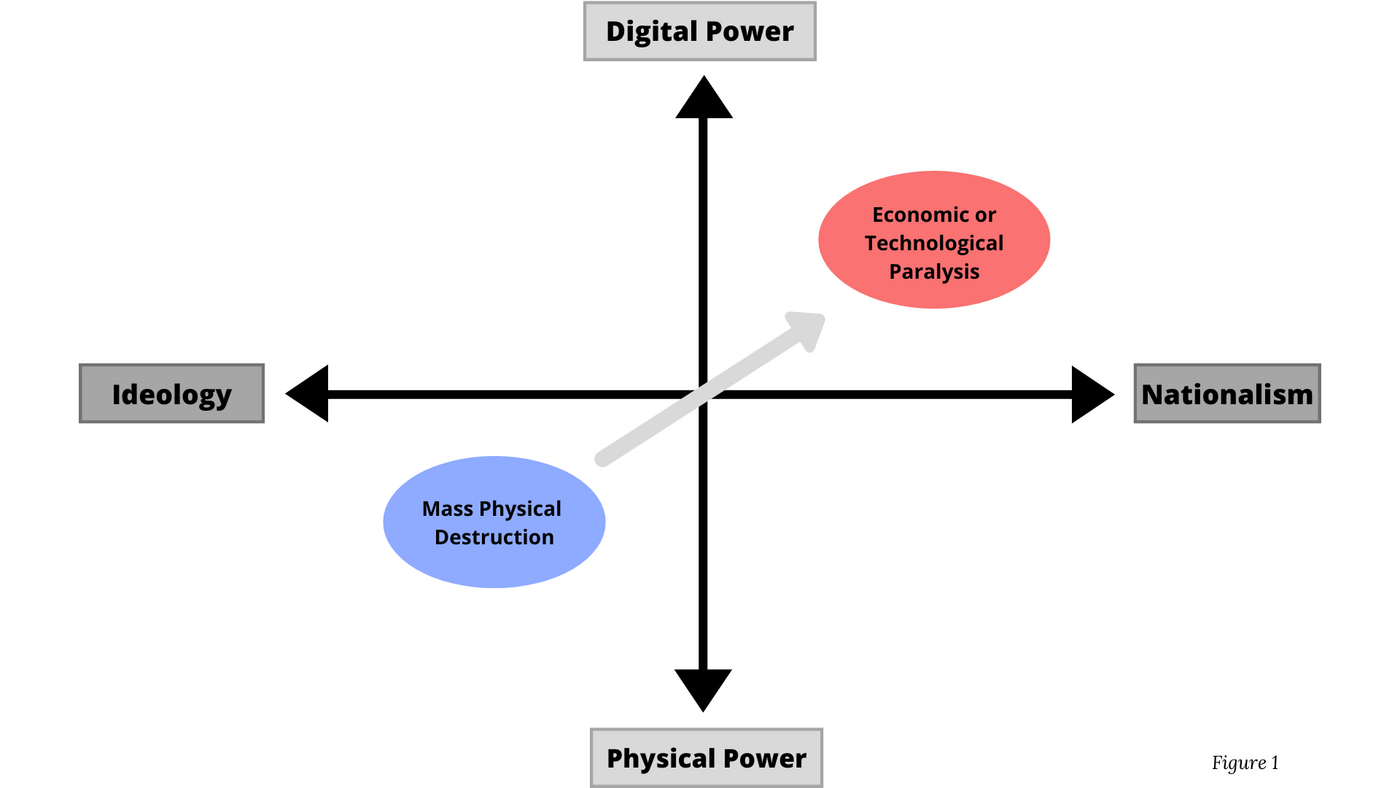
War and the Cold War 2.0. The weapons of the first Cold War were created to cause mass destruction of other nations, or at least give states the military power to suppress dissent. The key difference is that today’s weapons are no longer meant to cause mass destruction, rather the new objective is the complete paralysis of one’s enemy. In the post-World War II era, ideological discord between the U.S. and the Soviet Union (U.S.S.R.) was the key source of tension that created the first Cold War. Communism versus democracy was the rationale behind waging proxy wars and determining alliances with other nations. Today, ideology no longer drives decisions in the international system, rather it is nationalism that drives a state’s economic power, political decision making, and international influence. In addition, the rise of the digital era and focus on information technology have led nations to shift their focus from physical, hardware-based weapons to digital, software-based weapons. New information and communication technology (ICT) software and economic strength allow powerful countries to paralyze their adversaries using economic sanctions and various barriers to trade, cyberattacks, and other
technological software rather than using military might to destroy them. For the purpose of this paper, digital power is defined as any non-physical tactic or device used as a weapon while physical power is defined as any tangible tactic or device used as a weapon.
The shift to digital weapons backed by a nationalistic motive will result in the
marginalization of the original Cold War weapons. Gone will be the need to stockpile nuclear weapons, fighter bombers, assault rifles, battle tanks, and the race to develop the most lethal weapons. To take their place will be advanced technological software programs, drones, artificial intelligence, social media platforms, and 5G networking. These digital weapons play an important role in allowing countries to advance their economy and dominate the international system. And which countries currently lead in the most advanced weapons technology? None other than the U.S. and rising China (France-Presse, 2019).
The First Cold War
Why did the Cold War Start?
The beginnings of the Cold War were rooted deeply in the actions taken during
and after World War II. As the war came to an end, the differences between the ideology and post-war policy goals of the members of the Grand Alliance who won the war (the United States, the Soviet Union, and Great Britain) became overwhelmingly apparent. After the attack on Pearl Harbor cracked the facade that the United States was safe from foreign conflict, U.S. foreign policy began to shift away from its longstanding ideology of isolationism into international libertarianism (Roskin, 1974, 566). With this shift came the post-war intent of preventing another world war by increasing global interdependence through trade and investments, as well as the establishment of international organizations like the IMF, World Bank, and the United Nations – binding the fate of all states together (Gaddis, 2007, 26-27). In reference to President Wilson’s beliefs, the United States concluded that democratic countries do not start wars (Gaddis, 2007, 92). Whether this is true or not, it became a top priority of the U.S. to promote democracy, capitalism, self-determination, and economic integration throughout the world. Russia, on the other hand, had different post-war goals which included not just security for itself and the Soviet Union, but promoting communism around the globe to liberate the working class from the inequality created by capitalism (Gaddis, 2007, 86). Russia encouraged capitalist rivalries so that, eventually, the self-destruction of countries with free-market economies would allow Russia and communism to slowly dominate Europe (Gaddis, 2007, 27). Besides the apparent ideological differences between the post-WWII U.S. and Russia, there was deep-seated mistrust between the two countries. During the war, Stalin
was angered that the U.S. and Great Britain had “intentionally” taken their time to create the second front in North Africa in 1942, Italy in 1943, and finally Normandy in 1944, causing excess bloodshed for the Soviets (Gaddis, 2007, 19). In fact, by the end of the war, the Soviets had roughly 90 times more casualties than the U.S., whose total death toll was just under 300,000 (Gaddis, 2007, 9). Therefore, because Russia experienced the most bloodshed, Stalin believed that Russia should receive the most amount of land in the post-war settlements. However, his allies Roosevelt and Churchill had different post-war settlement objectives and Stalin felt deceived when Russia only received one-third of divided Germany and a sphere of influence only over Eastern Europe (Shen & Yu, 1998). This resulted in Stalin breaking almost all the promises he made at the Yalta Conference (Shen & Yu, 1998).
Finally, the obvious issue of the new atomic bomb and the future of nuclear
weapons caused uneasy tension between the U.S. and U.S.S.R.. The U.S. had collaborated and received help from the U.K. in the creation of the Atomic Bomb during the Manhattan Project. Meanwhile, the Soviets (also in the Grand Alliance with the U.S. and U.K.) were barely notified of the U.S.’s plans to bomb Hiroshima and Nagasaki, rather only knew of the new weapon via Soviet intelligence and spies (Gaddis, 2007, 54). This distrust between the U.S.S.R. and the U.S., and their equal desires to shape the new world order under their power, generated 45 years of deep-seated tension between the bi-polar world hegemons.
What Were the Weapons and Tactics Used During the Cold War?
Weapons of the 1900s were primarily constructed based on how much physical
damage they would cause and how much intimidation they would create. During the span of the Cold War, the more hardware-based, physical power weaponry a country could
build, the more ideological influence and hard power it had over other nations and the overall global order. The U.S. and U.S.S.R. used these hardware weapons to reinforce their dominance as well as reinforce their growing smart power. The possession of military power and nuclear weapons reassured their allies that the spread of the improper ideology would be stopped. The result was a security dilemma between the U.S. and U.S.S.R., who both heavily invested in physical weaponry that showed their military and ideological superiority. Weapons like these included a build-up of military men, armory, tanks, spy planes, and nuclear weapons including tactical weapons like missiles and strategic weapons such as the atomic bomb and the hydrogen bomb, just to name a few. While the build-up of nuclear weapons is well known, spy planes and espionage played important roles in many Cold War dilemmas. U.S. intelligence gathering and covert operations were carried out by the Central Intelligence Agency (CIA), supported by the Federal Bureau of Investigation and the National Security Agency. The Soviet equivalent was the KGB, a secret police force for state security, and the GRU, the foreign military intelligence agency of Russia. The most well-known uses of Cold War espionage include the Soviet’s use of top-tier spies to infiltrate the Manhattan Project and copy nuclear weapon blueprints with ease. In the Cuban Missile Crisis, the CIA’s U-2 spy plane discovered the Soviet missiles planted on the coast of Cuba aiming at the U.S. And the same U-2 spy planes made regular flights over Moscow and Leningrad, snapping pictures of the Soviet’s nuclear capabilities (Gaddis, 20, 73). What differentiated moderately powerful nations from the Cold War superpowers was the use of espionage as a physical weapon aimed at stopping the spread of the opposing ideology. Military alliances, like NATO and the Warsaw Pact, were also lesser-known physical weapons that promoted a specific ideology but were an equally valuable weapon in the first Cold War. Both alliances were built on the foundation of a collective ideology
and the commitment to stop the opposing superpower from gaining influence. Military alliances are categorized as physical weapons because these alliances resulted in a buildup of military arsenals in the form of tanks, armory, and troops ready to fight. At the very center of NATO’s alliance is the principle of collective defense, clearly outlined in Article V of the treaty which reads, “The Parties agree that an armed attack against one or more of them in Europe or North America shall be considered an attack against them all and consequently they agree that, if such an armed attack occurs, each of them… will assist the Party or Parties so attacked by taking forthwith… such action as it deems necessary, including the use of armed force, to restore and maintain the security of the North Atlantic area” (The North Atlantic Treaty Organization, 2009). The Warsaw Pact Treaty, created by the U.S.S.R. in response to NATO, similarly states, “In the event of armed attack… each of the Parties to the Treaty, in the exercise of its right to individual or collective self-defense per Article 51 of the Charter of the United Nations Organization, shall immediately, either individually or in agreement with other Parties to the Treaty, come to the assistance of the state or states attacked with all such means as it deems necessary, including armed force” (“Warsaw Pact Treaty,” 1955). These two military alliances, headed by the opposing Cold War rivals, was a clear indication of the U.S. and U.S.S.R.’s goal to advance their ideology using military alliances supported by hardware weapons if necessary. The “Space Race” also played a large part in the security dilemma between the U.S. and U.S.S.R. Starting with the Soviet launch of Sputnik in October of 1957, the first Earth-orbiting satellite, the race for who could build a larger space program began. As swiftly as new milestones were met, the race to surpass the next one began. From 1955 to 1975, the U.S. and U.S.S.R. launched the Luna, Vostok, and Apollo Missions, working against each other to put the first orbiting satellites in space, then animals, and finally
putting the first men on the moon (Royal Museums Greenwich, 2020). The Space Race was a clear battle between adversaries to develop the best hardware technology that would promote a nation’s soft power and in turn, their ideology. While less emphasized, the U.S. and U.S.S.R. also used other non-physical tactics to garner support, which can be labeled as digital power weapons. These software-based weapons took place in the form of propaganda, investments in social and humanitarian programs using USAID and the U.S. Peace Corps, colleges and universities, and Fulbright Scholarships. The goal was to improve the quality of life and infrastructure of their allies by improving their standards of education, living, and philosophy, which in turn helped the Soviets and Americans build their soft power worldwide and promote their ideology as superior. Propaganda was an especially important tool domestically for maintaining content and pride, which fueled nationalism and new scientific innovations in the U.S. and U.S.S.R. The Soviet Union’s official news source and the main organ of propaganda was the Pravda newspaper, which was largely controlled by the Tsar and was widely distributed throughout the nation to promote unity and communist pride (Encyclopedia Britannica, 2016). Given that propaganda could be seen as manipulation and deception for a state who values free enterprise and exchange of ideas, it was not until the U.S. Information and Educational Exchange Act (Smith–Mundt Act) of 1948 and the creation of the Psychological Strategy Board in 1951 did the U.S. government begin the “virtual crusade on communism” (Chisem, 2012). Democratic values were soon portrayed in every aspect of the arts, and iconic American items such as blue jeans and Coca-Cola bottles could be spotted in literature, music, and films.
How was the Cold War Resolved?
During détente, the cooling period between the U.S. and U.S.S.R. from 1969-1980 where both countries were facing domestic issues, efforts were made to de-escalate the tension. The results were treaties SALT I and SALT II which limited strategic nuclear weapons between the Soviets and Americans, the Anti-Ballistic Missile Treaty, and the 1975 Helsinki Accords which committed the Soviets to human rights efforts and reduced overall tension between the U.S. and U.S.S.R. (Gallagher, 2020). In the 1980s, Soviet leader Mikhail Gorbachev implemented his political and economic reform policy “Glasnost” and “Perestroika,” which translates to openness and restructuring, meant to increase transparency and boost the Soviet economy. Gorbachev’s
reform led to destabilizing the Communist Party. The failed “Perestroika” reform, in conjunction with the Soviet’s overexpansion with the Brezhnev Doctrine (Soviet foreign policy justifying intervention into socialist nations to preserve communism) and the Chernobyl nuclear disaster that diminished public belief, ultimately led to the dissolution of the Soviet Union and the fall of the Berlin wall (Gallagher, 2020). With the fall of the Soviet Union, the United States was able to become the number one superpower and fully step into the role of the world hegemon, dictating the international economic, social and political agenda for the last forty years.
The Cold War 2.0
History of the People’s Republic of China
Since the 1920s there had been an on and off domestic conflict in China between the Chinese Communist Party and the Nationalist Party. Following the end of WWII, an outright civil war broke out in China and after much bloodshed, on October 1, 1949, the Chinese Communist Party leader Mao Zedong declared the establishment of the People’s Republic of China (PRC) (U.S. Department of State Office of The Historian). The fall of mainland China to communism led to the U.S. to sever diplomatic ties with the PRC for thirty years. This included little trade and few contacts between the two countries. Chiang Kai Shek, the leader of the Nationalist Party, fled to Taiwan along with other members of the party in 1950 where the U.S. and the United Nations continued to recognize Taiwan as the Republic of China, refusing to acknowledge Communist China under Mao’s rule (U.S. Department of State Office of the Historian). In 1958 Mao launched the Great Leap Forward, an economic and socialist campaign for China, which proved to be a disaster causing millions of people to die of starvation as agriculture, industrial production, and domestic trade crashed (Yergin &
Stanislaw, 2008, 187). In the mid-1960s Mao launched the Cultural Revolution, a purging of all old culture and ideas, which also proved to be a failure causing mass violence. After Mao’s death in 1976, Deng Xiaoping emerged as China’s leader after challenging Mao’s successor Hua Guofeng (Yergin & Stanislaw, 2008, 188). Under Deng’s rule were many 20th-century turning points in Chinese History. In December of 1978, the decision of the 11th Congress of the CCP to reorient China towards the global market while maintaining Communist Party control transformed China’s economy into one of rapid economic growth (Yergin & Stanislaw, 2008, 189). Deng’s initial economic reforms started with agriculture. The government allowed peasant families to revert back to the old system: allocating individual sections of land to each family to till and deliver a certain portion of production to the state. However, the difference was that these peasants were now free to keep any extra output or sell it, which launched free enterprise in the PRC (Yergin & Stanislaw, 2008, 189-190). This increased the percentage of agricultural output sold in open markets as well as the income for farming households (Yergin & Stanislaw, 2008, 190). Coupled with the gradual decontrol of prices and the additional benefits to urban city dwellers, Deng’s agricultural reforms became a huge economic success. The mid-1980s was another turning point for the Chinese economy as it began high-speed growth under Deng’s plan for economic reform and liberalism. Deng’s Last Campaign, The Nanxun, was his final journey to southern China to promote open markets and the implementation of special economic zones, using the city of Shenzhen’s success as the model. Nanxun caught hold of the Chinese media via Hong Kong and soon led to a successful new commitment to Chinese economic reforms. This resulted in the 14th Party Congress affirming China’s shift from a “socialist planned commodity economy” to a “socialist market economy” in 1992 (Yergin & Stanislaw, 2008, 198).
The Rise of China
Since the 1990s, China’s GDP has grown at an exponential rate, becoming the second-largest economy in the world. The U.S. still holds its title for the largest economy with its nominal GDP standing at $21.44 trillion, making up 26.3% of the global economy, while China trails close behind with a nominal GDP of $14.14 trillion, making up 15.5% of the global economy (Silver, 2020). The Belt and Road Initiative, a Chinese initiative launched by Xi Jinping in 2013 with the potential to invest more than $1 trillion, aims to connect the Eastern Hemisphere through the means of land-based economic belt roads and maritime sea passages (Chatzky & McBride, 2020). This geopolitical and economic project will promote Chinese trade by expanding access to Chinese markets, boosting trade relations with Western nations, and securing stable long-term energy resources from Northern Africa and the Middle East, all the while decreasing the United States’ current international economic hegemony. Since coming to power, Xi has tasked the People’s Liberation Army with a full military reform to become a world-class military, accomplished through China’s Communist Party increasing control over the PLA (Kim, 2019). A larger military, coupled with the Belt and Road Initiative, means China’s increased influence over Asia and the East and South China Sea, allowing it to claim more territorial sovereignty and dominate regionally. This supports China’s vision to build geopolitical power for China over the Eastern hemisphere. In regards to technology, China is dominating in four main areas: manufacturing, digital platforms and its associated market, apps created to fix societal problems and basic science research & development (Schoff, 2019). “China is the second-largest spender on research and development (R&D) after the U.S., and China’s spending on
R&D grew by an average of 18% per year between 2010 and 2015,” which is four times the growth rate of the U.S. spending in R&D (Schoff, 2019). This type of increased technological innovation and dominance of Chinese networks comes with national security risks for countries across the world. Suspicion of Chinese companies storing and sharing global users’ private data or the increasing likelihood of cyberattacks is now a major threat to all wealthy nations.
Tensions Between the United States and China
Undeniably, the stark contrast in government systems between the U.S. and China
is the most obvious factor that has crippled the Sino-American relations since 1949. The fall of China to communism and the Soviet Union was a great blow to the U.S., whose largest battle at the time was stopping the spread of communism, which became popularized as “containment” under Eisenhower’s “Domino Theory.” Communism in China focuses on the needs and obligations of the community, while U.S. democracy emphasizes the rights and freedoms of the individual. Fears that a state ruled by communism could become a regional power in Asia led to the U.S. denying the existence of Communist China for 30 years. It was not until after the Sino-Soviet split that the U.S., during the Carter Administration, recognized China as the People’s Republic of China under Deng Xiaoping in 1979 and implemented the “One China Policy” (Gallagher, 2020). Just a few months later, the U.S. Congress signed the 1979 Taiwan Relations Act which allowed the U.S. to sell weapons to Taiwan, among other commercial and cultural relations, giving Taiwan the right to self-defense (Gallagher). Through these paralleled actions, the U.S. has been able to maintain relations with both the PRC and Taiwan for over 30 years. This agreement and the continued arms sale between the U.S. and Taiwan, which totaled over
$25 billion from 2017-2018, has only increased the tension between the U.S. and China (Albert, 2020). The U.S. and China have a history of disagreeing on the definition and acceptance of human rights. The U.S. is focused on universal human rights, which it promoted globally by leading the creation of the Universal Declaration of Human Rights and attending the Geneva Conventions. The U.S., along with a majority of the Western nations, believes intervening in foreign affairs to protect human rights is necessary. China believes in relative human rights, “which agree[s] on the supremacy of sovereign rights over human rights and [has] rejected humanitarian interference in domestic conflicts occurring within their boundaries” (Cho, 2011, 2). However, the main source of underlying tension between the U.S. and China stems from China’s history of deep humiliation at the hands of Western and Japanese imperialism in the 19th century. This humiliation sparked intense Chinese nationalism and its desire for international dominance. The Qing Dynasty was once powerful and prosperous, but China’s defeat in the Opium Wars with the British began China’s “Century of Humiliation” in 1839. This humiliation was only made worse by Japan’s invasion during World War II, domestic tension caused by the Chinese Civil War, Mao’s Great Leap Forward, and the Cultural Revolution. The humiliation of China ended once the state’s economy began to prosper again under Deng Xiaoping. However, the Century of Humiliation for China created an anti-Western sentiment among Chinese, passed down by the historical memory of defeat from the previous generations (Wang, 2014, 3). This historical memory of humiliation and anti-Western sentiments, a tactic used by leaders to promote their interests, fueled China’s strong nationalism (Wang, 2014, 3). Leader Xi Jinping embodies this nationalism, demonstrated by his long-term goal to regain China’s once-powerful dominance and global leadership by 2049.
More recent tensions between the U.S. and China stem from China’s trajectory to surpass the U.S. economy and gain primary influence in the international system. The U.S.-China trade deficit shows China’s trade surplus at $80.3 billion as of 2004, which has only continued to grow to $323.3 billion as of 2018 (Buchholz & Richer, 2019). As of May 2020, the U.S. had placed a total of $550 billion in tariffs on Chinese products since the start of the Trade War in 2018, while China had placed a total of $185 billion in tariffs on U.S. products (Chipman Koty & Wong, 2020). Finally, the U.S. and China have both developed nationalistic attitudes, promoted by their leaders President Donald Trump and President Xi Jinping. Nationalism, in short, is supporting and identifying with one’s own nation, driven by the desire for power at the detriment of others, where the loyalty to the state surpasses any other individual or group interests. In China, Xi’s nationalistic agenda and promotion of state objectives can clearly be seen in his goals to reinvent China as one of the most prosperous and technologically advanced countries. But these state goals come with great harm to Muslim Uyghurs, the rights of Chinese citizens, and Beijing’s foreign relationships with countries such as India, Japan, South Korea, and the Philippines. In the United States, President Trump’s support of an American-centric education, his withdrawal from the World Health Organization, and his “America First” slogan for economic nationalism and protectionism is nationalism at its heart (Evans). The competitive national interests of these two powerful leaders have strained U.S.-Sino relations, creating an environment for conflict.
The Cold War 2.0
Once again, the battle for global primacy has led to a security dilemma for the United States, only this time it is a competition for nationalistic supremacy by means of a technological advancement race rather than ideological supremacy by means of a military
arms race. Unlike the first Cold War, the victor of the Cold War 2.0 will be determined by who has the strongest capabilities to paralyze the other superpower. As China continues to grow its economy and surpass the United States as an economic superpower, the U.S. and China have come neck and neck in certain technological sectors as they try to overpower each other. The intensifying nationalism between the U.S. and China, led by their leaders, serves as a motive for the competition for global influence. In the spirit of continuing China’s growth, Xi has worked to increase China’s economic power through promoting Chinese technological innovations, investments in R&D, connecting the eastern hemisphere through the Belt Road Initiative, participating in international organizations, strengthening the Chinese military, and continuously promoting Chinese Nationalism. As China’s power continues to grow in these areas, the United States faces a serious national security threat. China’s ability to surpass the U.S. economically depends on its ability to manifest new digital weapons. New technological weapons include the creation of artificial intelligence, malware, and other advanced technology software, which increase the probability of cyberattacks and the sharing of private information and data. Cyberattacks pose a large threat to rich, developed nations such as the U.S. who are dependent on technology. Cyberattacks also risk immobilizing vital sectors of a nation, such as infrastructure, or exposing classified information, either by private or state-sponsored cyberattacks. While they may not trigger an armed conflict, cyberattacks have the ability to cause similar or greater economic and political damage by paralyzing their opponent. The security threat from economic software-like weapons has equal potential to paralyze an entire nation’s economy. Hefty sanctions or faulty trade agreements initiated by another state have the power to plummet a state’s economy and drive its people into
poverty. The Trade War between the U.S. and China is an aspect of the Cold War 2.0, representing the U.S.’s intentions to stop China from growing its economic power further by leveling export profits between the two states.
Weapons of the Cold War 2.0
Nationalism, rather than its ideological alignment, is now the main motivator of foreign policy decisions and the competition for international power. Given the emerging international trend that a state’s power is determined by its ability to paralyze another nation, dominant nations are now deviating away from weapons that cause mass physical destruction, resulting in the marginalization of the physical weapons used to advance a certain state’s ideology. While a nationalistic attitude can be a positive force, it is more commonly known for its destructive abilities, harming any state that stands in its way. When a state centers its decision making around nationalism, it typically results in deploying weapons that stunt or immobilize the growth of its competitor. The paralysis of a country can be done using digital power weapons, either economically or technologically, by stunting a state’s growth of a certain sector of the economy or using cyber-attacks to penetrate a state’s government or large corporation. To replace the previous physical power, ideology-driven weapons are new digital power, nationalistic-centered weapons. The original Cold War weapons are being replaced with novel software technology. Malware, data hacking, and advanced software programs are just a few ways a state can utilize cyber-attacks to paralyze another state’s economy. Technology companies like Huawei, that are global leaders in information and communication technology, have the potential to use 5G mobile networking for espionage and cyber warfare by disrupting communication or collecting and sharing user data with the
Chinese government, which could compromise U.S. security (Bowler, 2020). Social media platforms owned by the Chinese have gained an enormous amount of popularity among the youth, allowing for a faster way of communicating, but with the power to sway young minds. Tiktok, which is owned by ByteDance, a Beijing-based internet technology company, is a widely used mobile application that stores users’ data and employs an algorithm dictating what users watch. This is a serious national security threat to many nations and some states such as India have taken measures to ban this application and others in response to China overstepping its power (Abi-habib, 2020). Not only are these software technologies national security threats, but they allow China to expand their products to international markets, driving up the revenue of Chinese technology companies and increasing the geopolitical power of China’s economy. Nationalistic foreign policy also frequently employs economic weapons to paralyze an opponent. The costliest of these weapons are sanctions, financial penalties imposed by a state on another (which include tariffs), most commonly employed in attempts to force an adversary to comply with the other’s economic, political, or humanitarian goals. Though they may be useful for accomplishing some foreign policy goals, the costs are high and paralyzing, causing devastating food and medicine shortages and high job loss. Another economic weapon is currency manipulation, which artificially lowers the value of a state’s currency to make exports financially competitive. Currency manipulation, a tactic China has been accused of using, can deepen a trade war and cause harm to businesses and consumers alike. International intelligence and economic alliances also play a vital role in the Cold War 2.0. Sharing key intelligence among other nations maintains a strong bond between allies, allowing for effective and efficient collective effort when faced with an adversary. As each super power strives to attain more intelligence over the other, paranoia sets in,
potentially causing certain states to react irrationally. This digital weapon of intelligence sharing helps promote a state’s soft power and maintain global status. Five Eyes, created in 1941, is one of the oldest international intelligence alliances comprising the United States, United Kingdom, Australia, Canada, and New Zealand. Recent tension between China and the Five Eyes alliance has escalated as the five allied nations attempt to contain China’s growing power (Zheng, 2020). On the other hand, China’s intelligence thrives under Xi Jinping’s restructuring of the People’s Liberation Army’s intelligence from four general departments to 15 new agencies, resulting in more powerful and direct forms of espionage and data collection (U.S.-China Economic and Security Review Commission, 2019, 290). While China is in no major intelligence alliances, make no mistake, it still shares data and information with allies, such as Russia and Iran. Economic alliances, on the other hand, allow for the paralysis caused by economic weapons (sanctions, tariffs, and currency manipulation) to be multiplied, further harming the adversary. While the U.S. utilizes economic alliances, China has taken a different route towards self-sufficiency. Only time will tell which strategy will prove to be superior in determining global strength. While digital weapons are the trend, the U.S. and China both continue to invest in new physical weapons that bolster the strength of their economy and their allies’ economies. The economic development of the surrounding nations is equally as important as a nation’s internal development if a nation is to have strong trading partners and allies. The newest of these physical, nationalistic weapons is Foreign Direct Investment through the Chinese Belt and Road Initiative (BRI). While China’s BRI will have a beneficial impact on their economy, it serves an even larger purpose. The “BRI aims to bind West, South, and East Asia with Europe and Africa in a web of infrastructural connectivity, commerce, political cooperation, and military and energy security” which will result in
the sharing of Chinese and Asian culture, philosophy, and religion (Pröpper and Yann 2020, 1-9). This sharing of Chinese values, like communism and authoritarianism, along with Chinese culture is soft power in its purest form. The BRI will also allow China to advance its hard power by extending the reach of its military control beyond its borders. As Xi Jinping focuses on restructuring the PLA into a world-class military, China will be able to exert its dominance over neighboring nations. Through the BRI, China’s power over the Eastern hemisphere could potentially grow large enough to disband and reform economic and military alliances. New physical weapons also include recent innovations in surveillance technology through the use of satellites and drones. Beijing's deployment of drones to survey the South China Sea is an enormous win for China’s expansion of control over the heavily contested resource-rich maritime region, endangering economic trade routes and commerce primarily used by U.S.-allied ASEAN nations (Zhen, 2019). As satellite imaging and surveillance videoing capabilities advance, so do biometric databases with the onset of central government-run camera systems (ACLU). Large companies and government agencies have exponentially begun storing personal and private data, making this data an easy-to-locate target for cyber-attacks and privacy violations. Finally, international organizations such as the United Nations (U.N.) and the World Trade Organization (WTO) are tactful ways to garner global influence and achieve national goals by means of introducing and passing resolutions or settling trade disputes via the WTO dispute settlement system. While international organizations might not seem like a threatening form of weaponry, decisions made by these organizations can have a remarkable effect on which states receive more aid and support or who wins an economic dispute. China and the U.S. both battle for influence within international organizations, primarily on the U.N. Security Council where both states have permanent veto power.
The U.S. and China have brought many trade disputes to the WTO for settlements regarding tariff measures, renewable energy, and safeguard measures on imports (World Trade Organization). Most recently, China displayed greater soft power when it pledged to give an extra $2 billion to the WHO during the Coronavirus Pandemic while the U.S. terminated all funding to the WHO (Jacobs, Shear & Wong, 2020).
The Future of the Cold War 2.0
A few similarities should be considered when comparing the progression of the first Cold War between the U.S. and U.S.S.R. and today’s Cold War 2.0 between the U.S.
and China. Like the previous Cold War, nations will begin choosing sides between the U.S. and China more seriously. The new economic bipolar system currently stands divided with the U.S. and its strong allies the U.K., Australia, Canada, and Japan on one side, China and its allies Russia and North Korea on the other side, and states such as India who stand in the middle. India will have to commit to one side soon enough, and after growing tensions and recent border disputes between China and India, India is a likely ally of the U.S. The triad power between India, China, and America will play a critical role in the outcome of the Cold War 2.0, due to the economic strength and potential of all three nations. Meanwhile, through slow construction of the BRI, it is highly likely that a new alliance of Central Asian powers will emerge in support of China. These states could include Iran, Pakistan, Russia, Kazakhstan, Kyrgyzstan, and Tajikistan, some of which recently formed the Shanghai Cooperation Organization to work together on addressing terrorism and extremism (Lynch, 2020). In addition, the likelihood of China and the U.S. engaging in “proxy wars,” like those during the Cold War, over possible markets and resources in African states is highly probable and will be prolonged by the growing alliances. Another similarity to the first Cold War is the continuation of the “Space Race” between the U.S. and China. China became the third country to put a man on the moon in 2003. Since then, the Chinese Space Program has continued to expand its comprehensive list of different satellite launches, including those for communication and spying, and even announcing plans for a deep-space mission (Nova, 2008). The U.S. aims to put boots on the moon again in 2024, pushing up the deadline in response to China’s first soft-landing on the far side of the moon in January of 2019 (Wall, 2019). With China and Russia aggressively working to develop warfighting weapons for space-use, America
launched the United States Space Force in December of 2019 as the newest branch of the U.S. Armed Forces, focused on space warfare. The differences between the first Cold War and the Cold War 2.0 are more apparent. In conjunction with the transition from physical weapons focused on ideology to digital weapons promoted by nationalism, attacks on another country are now caused by overt cyber warfare planned by state-funded cyber hackers rather than covert operations performed by a state’s military and intelligence operatives. Instead of physically violating a state’s sovereignty, which resulted in amplified secrecy to avoid an armed conflict during the Cold War, a state’s ability to violate cyber sovereignty instead has led to more states claiming responsibility for their actions in the Cold War 2.0. This has already begun to come to fruition. In just 2020 alone, cyber-espionage campaigns created by Iranian hackers targeted air transportation and government actors in Kuwait and Saudi Arabia, and North Korean state-sponsored hackers sent phishing emails to five million businesses across the world, attempting to steal personal information and data (CSIS 2020). In May of 2021, a devastating cyber-attack on Colonial Pipeline forced the company to close over 5,500 miles of gas pipeline across the Southeastern United States, cutting off gas for millions of Americans and temporarily crippling the Southern American economy (Han, 2021). This cyberattack is thought to be the work of a cybercriminal gang named DarkSide, believed to be based in Eastern Europe (Han, 2021). As cyberattacks become more common, states and outside actors’ abilities to paralyze whole regions will become more destructive and more effective. While military alliances were once a vital weapon in determining a country’s strength and power, in this new digital age, military alliances are being replaced by economic and intelligence alliances. Today, a threat of attack is more prevalently caused by cyber warfare rather than nuclear weapons. Cybersecurity is a sector of the military
defense, and individual government defense organizations have shifted their focus to protecting and defending their technology rather than their men in combat. However, the continuance of military alliances to defend against cyberattacks is not only unnecessary but could waste state resources in maintaining the alliance or hold a state back from pursuing a cyber-predator. While NATO has shifted to make cyberwarfare one of its most recent priorities, member nations no longer have shared defensive interests. The divisions between member nations have been further exacerbated by policy differences on the Coronavirus pandemic, the Middle East, arms trade, and China’s rise (Brent, 2019) (Walcott, 2020). Not only could NATO and other military alliances become nonessential, but alliances like NATO could soon break apart indefinitely, instead, replaced with new technological, intelligence, and economic alliances. Finally, the Coronavirus pandemic is a major difference between the first and second Cold War and has intensified the divide between China, the United States, and their allies. China and the U.S. blamed each other for mishandling the situation. Disinformation campaigns from both countries continue to undermine trust and cooperation, inhibiting any possibility of future trade negotiations. China’s so-called “mask diplomacy” (the ability to mass-produce and distribute medical supplies and send medical experts worldwide) paved the way for Chinese soft power. The U.S.’s early failure to contain the virus plunged the American economy into the worst economic downturn of history since industrialization, leaving millions of Americans unemployed and fueling domestic riots for police reform and the Black Lives Matter movement.
Conclusion
As the Cold War 2.0 intensifies between the U.S. and China, the overall purpose of weapons will shift from causing mass destruction to nationwide paralysis by using software weapons to increase their economic power. These economic and technological digital weapons, over time, will result in the marginalization of nuclear and military weapons as states base their foreign policy decisions on nationalism rather than ideology. As the anarchy continues, the weapons of the Cold War 2.0 will be the deciding factor between which state will become the next world superpower.
References
Abi-habib, M. (2020, June 29). “India Bans Nearly 60 Chinese Apps, Including TikTok.” https://www.nytimes.com/2020/06/29/world/asia/tik-tok-banned-india-china.html. ACLU. (n.d.). “Video Surveillance.” Retrieved September 02, 2020, from https://www.aclu.org/issues/privacy-technology/surveillance-technologies/video-surveillance Albert, E. (2020, January 22). “China-Taiwan Relations.” https://www.cfr.org/backgrounder/china-taiwan-relations. Bowler, T. (2020, July 14). “Huawei: Why is it being banned from the UK's 5G network?” Retrieved September 02, 2020, from https://www.bbc.com/news/newsbeat-47041341 Buchholz, K., & Richter, F. (2019, May 10). “Infographic: U.S.-China Trade Deficit Keeps Growing Despite Tariffs.” https://www.statista.com/chart/16629/china-us-trade-deficit-grows/. Brent Laura Brent. “NATO's role in cyberspace.” Retrieved September 02, 2020, from https://www.nato.int/docu/review/articles/2019/02/12/natos-role-in-cyberspace/index.html Chatzky, A., & McBride, J. (2020, January 28). “China's Massive Belt and Road Initiative.” https://www.cfr.org/backgrounder/chinas-massive-belt-and-road-initiative. Chipman Koty, A., & Wong, D. (2020, May 15). “The US-China Trade War: A Timeline.” https://www.china-briefing.com/news/the-us-china-trade-war-a-timeline/. Chisem, J. (2012, August 16). “U.S. Propaganda and the Cultural Cold War.” Retrieved September 02, 2020, from https://www.e-ir.info/2012/08/16/u-s-propaganda-and-the-cultural-cold-war/. Cho, J. (2011). “Ideological competition between the United States and China in the field of human rights: Consequences for Chinese diplomacy.” ERAS, 12(2), 2. https://www.jus.uio.no/smr/english/about/programmes/china/Publications/articles_and_books/jch o.pdf. CSIS. “Significant Cyber Incidents.” https://www.csis.org/programs/technology-policy-program/significant-cyber-incidents. Evans, P. (n.d.). “Behind Trump's Rhetoric of Economic Nationalism.” Retrieved October 28, 2020, from https://globaldialogue.isa-sociology.org/behind-trumps-rhetoric-of-economic-nationalism/.
Falconer, R. (2021, April 22). “China's Government Tied to New Hack Attacks on U.S. Government and Businesses.” https://www.axios.com/chinas-government-tied-to-new-hack-attacks-us-8a95ec9f-d8aa-4f9e-9af3 -317607fce0c6.html. France-Presse, A. (2019, January 16). “China Has Some of the World's Most Advanced Weapon Systems, Pentagon Warns.” https://www.theguardian.com/world/2019/jan/16/china-has-some-of-worlds-most-advanced-weap on-systems-pentagon-warns. Gaddis, J. L. (2007). The Cold War: A New History. Penguin Books. Gallagher, Maryann. “The Cold War” Class Lecture, American Foreign Policy from the University of Georgia, Athens, GA, February 2020. Gladstone, R. (2020, July 22). “How the Cold War Between China and U.S. Is Intensifying.” Retrieved September 04, 2020, from https://www.nytimes.com/2020/07/22/world/asia/us-china-cold-war.html. Han, N. (2021, May 12). “Colonial Pipeline shutdown could impact millions of consumers, expert warns.” 6abc Philadelphia. https://6abc.com/colonial-pipeline-gas-prices-cybersecurity-cyberattack/10614969/. Jacobs, A., Shear, M. D., & Wong, E. (2020, May 18). “U.S.-China Feud Over Coronavirus Erupts at World Health Assembly.” Retrieved September 02, 2020, from https://www.nytimes.com/2020/05/18/health/coronavirus-who-china-trump.html. Kang, C., & Sanger, D. (2019, May 15). “Huawei Is a Target as Trump Moves to Ban Foreign Telecom Gear.” Retrieved September 04, 2020, from https://www.nytimes.com/2019/05/15/business/huawei-ban-trump.html. Kim, Patricia. “Understanding China's Military Expansion: Pacific Council on International Policy.” Pacific Council, September 19, 2019. https://www.pacificcouncil.org/newsroom/understanding-china’s-military-expansion. Louis Pröpper, Henrik Yann. 2020. “The ‘Chinese Dream’: An Analysis of the Belt and Road Initiative.” International Social Science Review 96 (1): 1–24. http://search.ebscohost.com.proxy-remote.galib.uga.edu/login.aspx?direct=true&db=bth&AN=14 2503555&site=eds-live.
Lynch, I. J. (2020, June 03). “What Are the Implications of China's Growing Security Role in Central Asia?” Retrieved September 02, 2020, from https://thediplomat.com/2020/06/what-are-the-implications-of-chinas-growing-security-role-in-ce ntral-asia/. Mcneil, D., & Jacobs, A. (2020, May 29). “Blaming China for Pandemic, Trump Says U.S. Will Leave the W.H.O.” Retrieved September 04, 2020, from https://www.nytimes.com/2020/05/29/health/virus-who.html. Nova. (2008, February 12). “The Space Race Today.” https://www.pbs.org/wgbh/nova/article/space-race-today/. O'Keeffe, K. (2018, December 04). “U.S.-China Tensions Go Beyond Trade Conflicts.” Retrieved September 04, 2020, from https://www.wsj.com/articles/u-s-china-tensions-go-beyond-trade-conflicts-1543892461. O'Keeffe, K., Viswanatha, A., & Wong, C. (2020, July 23). “U.S. Orders China to Close Houston Consulate.” Retrieved September 04, 2020, from https://www.wsj.com/articles/china-u-s-ordered-us-to-close-our-houston-consulate-11595407075. Roskin, M. (1974). “From Pearl Harbor to Vietnam: Shifting Generational Paradigms and Foreign Policy.” Political Science Quarterly, 89(3), 563-588. doi:10.2307/2148454. Royal Museums Greenwich. (2020, April 6). Space Race Timeline. https://www.rmg.co.uk/discover/explore/space-race-timeline. Schoff, James L., and Asei Ito. “Competing With China on Technology and Innovation.” Carnegie Endowment for International Peace, October 10, 2019. https://carnegieendowment.org/2019/10/10/competing-with-china-on-technology-and-innovationpub-80010. Shen, Z., & Yu, W. (2019). How did Stalin fall into the “Thucydides Trap”: How Soviet–US relations shifted from cooperation to confrontation after World War II. China International Strategy Review, 1(2), 252-268. doi:10.1007/s42533-020-00032-0. Silver, C. (2020, April 17). “The Top 20 Economies in the World.” https://www.investopedia.com/insights/worlds-top-economies/. The North Atlantic Treaty Organization. (2009, April 01). The North Atlantic Treaty. Retrieved September 02, 2020, from https://www.nato.int/cps/en/natolive/official_texts_17120.htm.
U.S.-China Economic and Security Review Commission. (2019). 2019 Report to Congress (Vol. Chapter 2, Section 3, pp. 289-300) (United States, Congress, U.S.-China Economic and Security Review Commission). Washington D.C.: U.S.-China Economic and Security Review Commission. Retrieved September 02, 2020. U.S. Department of State Office of the Historian. “The Chinese Revolution of 1949.” Retrieved September 02, 2020, https://history.state.gov/milestones/1945-1952/chinese-rev. Wall, M. (2019, March 27). “US Is in a New Space Race with China and Russia, VP Pence Says.” https://www.space.com/new-space-race-moon-mike-pence-says.html. Walcott, J. (2020, June 19). “Why the Alliance Between Europe and America is Falling Apart.” Retrieved September 03, 2020, from https://time.com/5855200/us-europe-alliance-failing/. Wang, Z. (2014). Never forget national humiliation: historical memory in Chinese politics and foreign relations. Columbia University Press. Westcott, B. (2020, May 15). “US-China tensions didn't begin with the coronavirus. They've been building for years.” Retrieved September 04, 2020, from https://www.cnn.com/2020/05/13/asia/us-china-coronavirus-tensions-intl-hnk/index.html. World Trade Organization. (n.d.). Chronological list of disputes cases. Retrieved September 02, 2020, from https://www.wto.org/english/tratop_e/dispu_e/dispu_status_e.html. Xuanzun, L. (2020, August 28). “Chinese military expels US destroyer from territorial waters in S.China Sea.” Retrieved September 04, 2020, from https://www.globaltimes.cn/content/1199140.shtml. Yergin, D., & Stanislaw, J. (2008). The Commanding Heights: the battle for the world economy. Free Press. Yuqiao, J. (2019, September 1). “China's R&D input hits 2 trillion yuan for 2018.” Retrieved September 04, 2020, from https://www.globaltimes.cn/content/1163342.shtml. Zhen, L. (2019, September 10). “Beijing deploys drones for South China Sea surveillance.” Retrieved September 02, 2020, from https://www.scmp.com/news/china/military/article/3026577/beijing-deploys-drones-south-china-s ea-surveillance. Zheng, S. (2020, June 20). “Why is the Five Eyes intelligence alliance in China's cross hairs?” Retrieved September 02, 2020, from
https://www.scmp.com/news/china/diplomacy/article/3089564/why-five-eyes-intelligence-allianc e-beijings-cross-hairs.