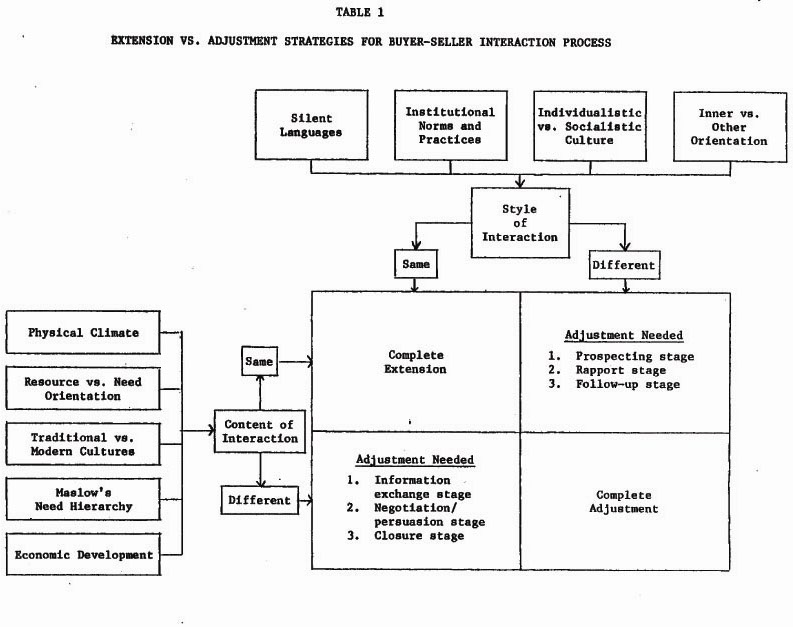
A vast number of marketing transactions are undertaken in the international arena. Therefore, we need to understand cross—cultural differences in selling and negotiations. Each transaction has a dimension of content (what you offer) and style (how you offer). The paper discusses how certain cultural factors affect he content aspects and other cultural factors affect the style aspects of international buyer—seller negotiations. Finally, the paper suggests which of the six stages (prospecting, rapport, information, persuasion, closing, and follow—up of personal selling need to be changed in the presence of different types of cultural factors.
Introduction
Even though buyer—seller interaction/negotiation process is receiving increasing attention from the marketing scholars (Capon Hulbert, 1976; O’Shaughnessy, 1972; Sheth, 1976; Wilson, 1976; Woodside, Bennett & Sheth, 1977), there is virtually nothing in the literature on the influence of cross—cultural and cross—national settings in which negotiations take place. And yet, we must reckon with the cross—cultural influences on buyer—seller interaction/negotiation process simply because a vast number of marketing transactions transcend national and cultural boundaries. In other words, multinational and transnational marketing has emerged as a way of life and transactions between buyers of on country/culture and sellers of another country/culture are commonplace. The purpose of this paper is, therefore, to discuss the cross—cultural influences on buyer—seller interaction process, and to provide a conceptual framework which may become useful for future empirical research.Need For Understanding Cross—Cultural Influences
There are a number of reasons to study and understand cross—cultural influences on buyer—seller interaction/negotiation process. First, despite market research and market opportunities, there is an abundance of international business blunders (Ricks, Fu & Arpen, 1974). The post mortems performed on past marketing mistakes strongly suggest that most mistakes occur in the process of carrying out marketing plans rather than in basic thinking. In other words, it is the execution of marketing plans in terms of interpersonal communication, negotiations and mass communication where most mistakes occur. Therefore, the message is clear: The cross—cultural setting creates situations in which the mar— hater must decide whether he should extend or adjust his way of doing business in a foreign market. Second, the dependence on transnational markets for technical/industrial products is increasing. It would appear that engineering concepts of experience curve (Conley, 1970) is more and more compelling the manufacturers of highly technical industrial products to think of worldwide market potential to achieve competitive cost and price advantages. While this, was invariably recognized by most European countries due to their small domestic markets, it is also being increasingly felt by the United States and many large developing nations such as India, Brazil and China. This increasing dependence on transnational markets leads to more marketing transaction in cross—national setting.. Third, it is almost universally recognized today that there is a true interdependence relationship between the advanced industrial nations (North countries) and the developing nations of the third world (South countries). One cannot industrially and economically survive without access to market, natural resources and capital of each other. Given the fact that cultural differences are far greater between the North and the South countries, it is inevitable that cross—cultural influences must be recognized and understood to make this interdependence work. At a very macro level, the failure of the recent UNIDO conferences in Lime (Peru) and New Delhi (India) to generate a dialog between the North and the South countries is a good indication of the complexity of cross—cultural differences in industrial negotiations. Fourth, international trade is growing at a rapid rate for most nations (Sheth, 1980). Both exports and imports are an integral part of any nation’s industrial development including East European and Socialist countries. Furthermore, international trade is not limited to bilateral agreements but extended to multilateral agreements and arrangements. Organizations such as UNCTAD and GAIT are a testimony to the growth of worldwide international trade. Therefore, buyer—seller negotiations and interaction processes are more and more likely to be subjected to cross— national and cross-cultural influences. Finally, future growth for most traditional products in both consumer and industrial goods is likely to come from the Asian and African markets. Of course, the primary reason for this is that markets in the industrialized world are becoming mature or stagnant whereas the Asian and African markets are at the growth stage. While we know a little, about cultural and national differences among the industrialized markets, we know very little about the unique cultures of Asian and African markets. At the same time, we do believe that our learned experiences from the European context are not likely to be generalizable to these new and culturally unique markets. in summary, all of the above five reasons for the need to understand cross-cultural influences on buyer—seller interaction process have one coon denominator: Marketing transactions involving exchange and negotiations between buyers and sellers are increasingly taking place in the world arena rather than in the domestic market.Dimensions Of Buyer-Seller Interaction Process
Before we discuss cross—cultural influences, we need to define and describe the buyer—seller interaction/negotiation process. Fundamentally, it consists of two dimensions: content sad style of interaction/negotiation (Sheth, 1976) . Content of Interaction: The content dimension of interaction process represents the substantive aspects of the purposes for which the two parties (buyers and sellers) get together. It, therefore, includes, suggesting, offering, promoting and/or negotiating a set of product/service exchange specific values and their expectations. The content dimension is presumed to consist of the following vector of exchange specific values and their perceived expectations:- Functional Values representing the instrumental values associated with the product/service involved in the exchange/interaction process such as the engineering specifications, packaging features, product safety and other consequences directly related to the functions for which a product/service is designed and offered.
- Social/Organizational Values reflecting the nonfunctional values associated with a product/service because of its image or stereotypes as being most appropriate for certain socioeconomic, demographic and cultural groups or certain types of organizations and institutions. For example, an automobile may acquire social value as a prestige or stat us symbol by being associated with certain upscale social groups. Similarly, a computer system ray possess organizational value by being associated with basic R&D institutions such as NASA or NSF.
- Personal/Emotional Values representing those nonfunctional values which are created by the product/service being associated with certain personality types or with certain emotions. For example, a cigarette may be considered a masculine cigarette (Marlboro) or a liberated woman’s cigarette (Virginia Slims) because of its association with certain personality and emotional traits. Similarly, a nuclear reactor may be perceived as something to be feared because of the emotional feelings it arouse.
- Epistemic/Innovative Values represent those nonfunctional values which are generated by the product/service being perceived as something new, different, or as a change of pace substitute for what is otherwise, a routine habitual choice. It reflects novelty and curiosity appeal built in a product/service. Most tourist attractions seem to be dominated by epistemic values. Similarly, most fads and fashions are dominated by innovative value. Even in industrial products, role of epistemic/innovative values is significant in most of f ice equipment and decoration product categories.
- Task—Oriented Style represents preference for those ground rules which facilitate the accomplishment of interaction and negotiations in the most efficient and productive manner with respect to time, money and effort considerations. Task—oriented style reflects the professionalism in the buyer—seller interaction process. Every activity in the negotiation process is considered essential and its format, structure and organization with other activities are optimal. For example, task-oriented people get impatient with social chitchat, bureaucratic paperwork or delays, and generally prefer mechanical precision and speed in various tasks. The obvious stereotype of task— oriented style is the American way of doing business in international business. Among the Europeans, the Germans are exemplified by the task—oriented style.
- Tradition—Oriented Style represents preference for those ground rules which are normatively set by others and have been historically used in a particular transaction. It is most critical that the rituals, mannerisms and formats established by tradition be observed even if it results in less efficiency and productivity in the process of negotiating.
The obvious stereotypes of tradition-oriented style are the Middle— East and the Far—East countries’ ways of negotiating business transaction.. Among the Europeans, the British tend to reflect the tradition—oriented style.
- People—Oriented Style represents preference for those ground rules in a negotiation/interaction process which are set by the personal interests and backgrounds of the parties (actors) involved In it. In other words, what matters in the ground rules for negotiations is based on “who is who” or “who knows who.” attributes. Both parties In the interaction process ar. more interested In the personal and social preferences, habits and backgrounds rather than in task accomplishment or tradition achievement.
Cross—Cultural Influences On Content Dimension
Eased on past research compilation in cross—cultural psychology (Triandis, 1979) and in cross—cultural consumer behavior (Sheth and Sethi, 1977), we have identified five major dimensions of cross—cultural differences which will impact on the content aspect of buyer—seller interaction process. We will examine each dimension in some detail and show how it brings about differences in the four values (functional, social, personal, epistemic) associated with content of interaction/negotiation.- Resource vs. Need Orientation. It is possible to examine cultures and nations with respect to their fundamental societal value system which reflects whether they are more dominated by resource conservation or need satisfaction. For example, certain cultures are more concerned with ecology and coexistence between man and his natural surroundings. On the other hand, other cultures believe that natural resources are for the use of mankind and its need satisfaction. Whether a culture is resource oriented or need oriented will clearly dictate the balance between functional and nonfunctional values in a product/service sought and offered in a transaction. Our hypothesis is that resource oriented cultures will be more driven by functional values whereas need oriented cultures will be more driven by nonfunctional values.
- Traditional vs. Modern Cultures. A second major dimension on which cultures vary is the degree to which they are traditional or modern in their outlook and values. Presumably, the higher the degree of modernity, the greater is the propensity to change. Accordingly, more modern cultures will manifest more epistemic/innovative values in a transaction than the traditional cultures. Similarly, more madam cultures will be driven by self—oriented personal values whereas more traditional cultures will be driven by social stereotypes and product imageries.
Our hypothesis is that modern cultures will mainfest more epistemic and personal values in the interaction process and less social values as compared to the traditional cultures.
- Climate. The physical environment of countries have a lot to do with cultural values. In fact, some even believe that cultural differences represent mostly climatic differences. There is no question that physical climate will influence the content dimension of buyer—seller interaction process. For example, the specific functional values desired in a given climate will be significantly different than in another climate with respect to storage, packaging, preservation, use and disposal activities associated with a product/service. Thus, people living in hot climates will wear open air sandals whereas people in cold climates will wear shoes or boots; people living in deserts will have far more imaginative ways to conserve water than people who live near lakes and rivers.
Our hypothesis then is that physical climate as a cultural trait will create differences within functional values of products/services across cultures.
- Economic Development. The basic cross—cultural difference with respect to economic development is the predominance of time versus money as the scarce resource. It would appear that money will be the dominant constraint in less developed countries whereas time will be the dominant constraint in advanced industrialized nations. The vast life style differences between third world countries and industrialized nations can be easily attributed to this fundamental difference in money versus time as the scarce resource.
Our hypothesis, therefore, is obvious: Degree of economic development will create differences in the functional values of a product/ service across different cultures. In particular, far more convenience values associated with time and place will be patronized by advanced countries as compared to less developed nations.
- Maslow’s Need Hierarchy. Cultures also vary in terms of the dominance of specific needs in Maslow’s need hierarchy. For example, less developed nations by and large tend to be dominated by safety/security and physiological needs, whereas the more advanced countries tend to be dominated by love/affection and self—esteem needs. This difference in dominance of needs is bound to generate cross—cultural differences in product/service values. For example, the only way you can successfully sail religion in less developed countries is to claim that God will protect you, whereas in most advanced countries, it is imperative to claim that God loves you.
Our hypothesis, therefore, is that more nonfunctional values in a product/service will be manifested in chose cultures which are dominated by love/affection and self—esteem needs, whereas more functional values will be dominated in less developed countries.
While these five factors are found to be most significant determinants of cross—cultural influence on buyer—seller interaction process, they are neither mutually exclusive nor exhaustive. In fact, our a priori thinking suggests chat they are likely to be correlated with one another, Furthermore, many other cultural characteristics such as abstract-concrete thinking, literacy rate, population homogeneity and others are also likely to be relevant. However, these five factors seem more fundamental and universal.Cross-cultural Influences on style dimension
The style aspect of buyer—Seller interaction / negotiation process is likely to be influenced by several other cultural practices and procedure. We will again examine the most significant aspects and hypothesized their impact on the three style dimension.- Silent Language In a classic book, Rail (1959) has brilliantly summarized a number of cultural traits which generate significant differences in business practices across cultures sad countries. He calls them as the silent languages of time, space, friendship and business agreements. The basic idea is that cultur.5 vary in their values and perceptions on these four factors which are so deep rooted that they are never explicitly discussed, and they almost subconsciou.sly create differences in the way people conduct their business practices. For example, a Westerner is perceived to be very time— conscious, prefers spatial distance, believes in legal written agreements, and friendship is not above economic or monetary considerations as compared to an Easterner.
Our hypothesis is that silent languages will produce significant cross—cultural differences in task—oriented versus people oriented styles of interaction.
- Institutional Norms and Practices. A second cultural trait to impact on the style dimension is the institutional norms and practices. They include differences in organization structure, communication, coordination and control as well as in managerial decision—making process which can be attributed to centralized vs. decentralized power structure, and autocratic vs. bureaucratic ways of doing business. For example, the American institutions tend to be decentralized and autocratic, whereas the Japanese institutions tend to be centralized and bureaucratic resulting in “management by authority” versus “management by consensus” philosophies of conducting business transactions.
Our hypothesis related to institutional norms and practices is straight forward: Cultures will vary in their task—oriented style of negotiation/interaction process depending on whether they are bureaucratic vs. autocratic and whether they are centralized vs. decentralized in their power structure.
- Individualistic vs. Socialistic Orientation. Cultures also vary with respect to the freedom they provide for expressing highly Individualistic behavior or constraining it with a lot of social norms and legal rules. Individualistic cultures tend to encourage and reward persona l achievements, whereas socialistic cultures tend to reward societal achievements. The obvious stereotypes that come to mind are the United States where personal freedom and achievement are the dominant traits as compared to China where collective behavior and achievement are the dominant traits.
It is hypothesized that individualistic cultures will be less tradition—oriented in their style of negotiation/interaction than socialistic cultures.
- Inner vs. Other Orientation. Riesman’s (1950) classification of inner—directed, other—directed and tradition—directed people is another major cultural trait which is likely to influence the style aspects of negotiation/interaction. In fact, Riesman’s three—fold classification almost parallels the three types of style discussed in this paper. According to Riesman, other—directed people and cultures tend to be influenced by other people’s desires, values and expectations, inner—directed people and cultures tend to be driven by their own personal, philosophy and code of conduct; and tradition—directed people and cultures tend to be driven by patterns established by past generations.
We, therefore, hypothesize that other—directed cultures will tend to be more people—oriented in their style of interaction/negotiation, whereas tradition—oriented cultures will be more tradition-oriented in their style of negotiation/interaction. Finally, self—oriented cultures will b. task-oriented only if their silent languages are task-driven rather than people—driven.
Once again, what we have identified and discussed here as cultural determinants of style represents only the major factors for which there is convergent validity as wail as some predictive, validity in the literature. There may be other factors either as correlates of the above four or as additional cultural determinants of style aspects which are not discussed here.